Martial Arts · Martial History & Supporting Studies
Free preview
A clue is not proof
Lesson 1 of Identifying Martial Styles. Anyone can read this lesson with no account. Every lesson after this one is for students.
Learn to observe
Learn to separate what you can see from what you are guessing, then support a careful conclusion.
You see someone raise both hands and place one foot forward. What martial art do they practice? You do not have enough information yet. Many people use that position. A useful scholar begins with a smaller statement: “Their hands are raised, and one foot is ahead of the other.” That statement describes the evidence instead of racing past it.
In this course, a clue is something that helps you investigate. Proof would establish a particular claim. Most short martial arts clips give clues, not proof of a person's complete training.
1What to look for
Watch actions that repeat. Notice the distance between people, what they do with their hands and feet, whether they hold each other, and what happens when someone reaches the floor. Also notice the setting. Are you watching a class, a performance, a planned demonstration, or a competition?
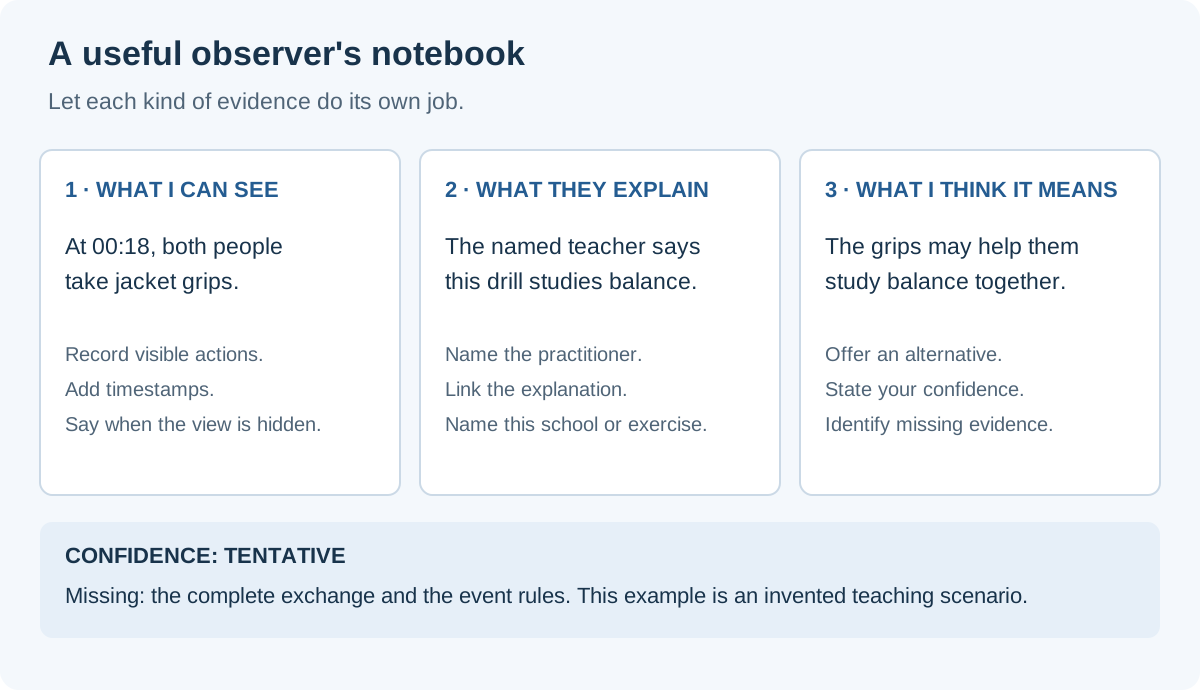
Ask another question: What problem is this practitioner trying to solve? Look for a teacher's own explanation of the task. Keep three things separate: what is visible, what the teacher or student says, and what you infer. A named teacher explaining their exercise is a first-party source for that explanation; it does not speak for every school or prove what every student feels.
A title can provide useful context, but a title is a claim made by its publisher. Keep it separate from what you can actually see. A uniform, accent, appearance, or country of origin does not prove a person's style.
2How it works
Use four short steps: observe, suggest, check, qualify. Observe means describe the action. Suggest means offer a possible explanation. Check means look for supporting information. Qualify means explain the limits of your conclusion.
Here is an invented observation, used for practice rather than as evidence about a real athlete:
“Two people wear gloves. During the visible twelve seconds, they exchange punches and move apart. I see no kicks. Boxing is one possibility. However, kickboxing competitors also punch, and the clip might show a hands-only class drill. I would check the full event title and rules before choosing.”
Notice the difference between “I see no kicks in these twelve seconds” and “These people do not know how to kick.” The first statement fits the evidence. The second adds a claim the clip cannot support.
Use an observation notebook with three columns: What I can see; what they explain; what I think it means. In the last column, add an alternative explanation, your confidence, and what evidence you need next. This makes your thinking easy to review. You can change an answer when new evidence appears. Revising an answer is part of doing the work well.
Add the teacher's name, source, and stated aim when available. If a practitioner describes feeling pressure, losing balance, or noticing an opening, attribute that report to them. You cannot read those sensations from the outside.
1Rules change the picture
Rules can make two activities look different even when the athletes have similar training. United World Wrestling's rules explain that freestyle permits leg attacks that Greco-Roman prohibits. A wrestler avoiding the legs may be following a rule, not revealing an inability.
The same caution works in other arts. A participant may leave out a technique because it is prohibited, outside the drill, inappropriate for that age group, or simply unnecessary in the short exchange you saw.
2What to expect in supervised practice
Expect to ask questions before joining an unfamiliar activity: “What is this exercise?” “What actions are permitted?” “How do we stop?” Follow the instructor's answer and the school's practice rules. You do not need to surprise a partner or test a dangerous technique to complete an observation exercise.
For this scholar course, watching approved material and explaining your evidence is enough. Physical rank skills are assessed separately.
3Look-alikes and limits
Someone may train in several systems. They may change their movement for a particular partner, injury, demonstration, or rule set. Even a correct identification of the event does not establish everything the individual knows.
Confidence means how strongly the available evidence supports your statement. Use plain labels such as “possible,” “likely in this context,” and “not enough evidence.” Do not add a precise percentage unless you have a real method for calculating it.
4Observation exercise
Imagine a silent clip showing two people holding jackets. One turns, and both leave the camera frame. Write three observations that remain true without seeing the ending. Then list two possible activities and one piece of missing information.
A careful start is: “Both people have jacket grips. One turns their body. The ending is outside the frame.” You cannot yet say that a legal throw scored, that someone won, or that the activity must be judo. A full clip and its event information would help.
5Check yourself
Sources
- United World Wrestling, International Wrestling Rules, January 2026, foreword: https://cdn.uww.org/2026-01/wrestling_rules.pdf
- Association of Boxing Commissions, Unified Rules of Professional Kickboxing, permitted strikes and fouls: https://www.abcboxing.com/unified-rules-kickboxing/
The observation scenarios in this lesson are original teaching examples, not descriptions of recorded matches.
Continue with the full course
This free preview is lesson 1 only. Enroll to open the rest of Identifying Martial Styles.