Skip to content

Martial Arts · Martial History & Supporting Studies

Identifying Martial Styles

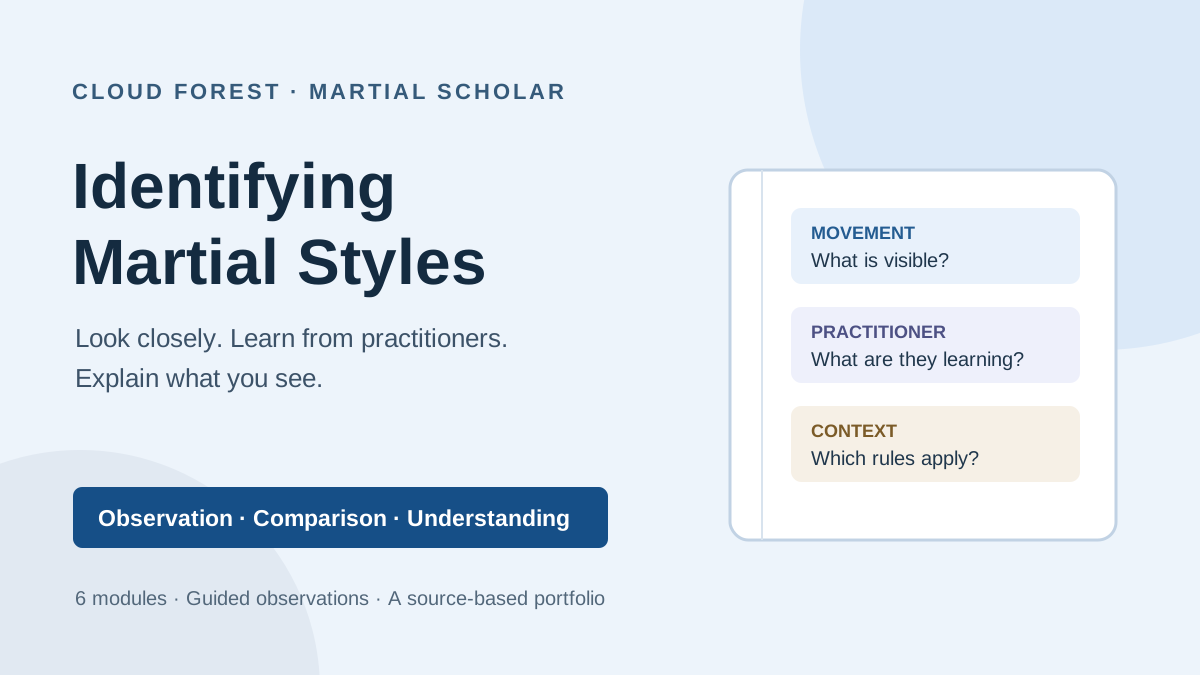
See martial arts through movement, rules and their practitioners’ teaching.

Level
Beginner
Lessons
30 lessons in 6 modules
Estimated study
About 10.5 hours
Format
Online, self-paced

Study access and rank credit

Study at your own pace. One instructor-approved portfolio can count toward both Shaolin and Street Jujitsu. Audit access alone does not include rank assessment.

Portfolio checklist and submission status

Monthly: $0 today with a card, then $34 on day 4 unless you cancel before then. After the trial, 30 days' notice applies. Active on-campus students have academy access included. Check your existing student account before buying another subscription.

Before you start

Review the lesson outline and any lesson-specific preparation before you practise.

Full study requires active Academy access. This course can be audited independently of optional assessed programs.

About this course

Learn how popular martial arts use stance, movement, distance and technique. Explore named practitioners’ explanations of what they train for and why. Compare specific rules, recognize look-alikes and explain what the evidence shows. This shared scholar course supports both Shaolin and Street Jujitsu ranking requirements.

What you will be able to do

  • Describe visible stance, guard, movement, range and technique in plain language.
  • Compare common martial systems while recognizing variation between schools and competition formats.
  • Connect a named practitioner’s teaching aims to visible movement, with the source and school clearly identified.
  • Explain how a named rule set changes the actions and movement you may see.
  • Support an identification with evidence, consider alternatives and state uncertainty.
  • Prepare a source-based observation portfolio that an instructor can assess once for shared ranking credit.

Course outline

Start with visible evidence, simple movement words and the rules of the activity.

  1. A clue is not proof20 minFree preview
  2. Where the action happens20 min
  3. Read stance and movement20 min
  4. Rules change the way people move20 min

Compare Chinese systems while keeping forms, partner drills and combat sport distinct.

  1. Shaolin and Longfist: a family resemblance20 min
  2. Wing Chun: working at close range20 min
  3. Tai Chi Chuan: slow practice and partner work20 min
  4. Xingyiquan: connected forward movement20 min
  5. Baguazhang: turning and changing direction20 min
  6. Sanda: Chinese combat sport20 min

Notice the hands, feet, distance and rules without treating one stance as proof.

  1. Boxing: hands, footwork and defense20 min
  2. Muay Thai: striking and the clinch20 min
  3. Kickboxing: one name, several rule sets20 min
  4. Karate: many schools, many competitions20 min
  5. Taekwondo: recognizing different formats20 min
  6. Capoeira: movement inside a roda20 min

Read grips, takedowns, throws and ground positions in the correct competition or training context.

  1. Wrestling: takedowns and control20 min
  2. Judo: grips, throws and groundwork20 min
  3. Brazilian Jiu-Jitsu: position and submission20 min
  4. Japanese jujutsu: investigate the school20 min
  5. Sambo: sport and combat are different contexts20 min

Study transitions, scenario practice and varied living traditions without inventing universal rules.

  1. Mixed Martial Arts: transitions between phases20 min
  2. Krav Maga: a curriculum, not one universal contest20 min
  3. Silat: a wide family of traditions20 min
  4. Arnis, Eskrima and Kali: names and training context20 min
  5. Cloud Forest Street Jujitsu: connect evidence to the school syllabus20 min

Practice comparisons, explain uncertainty and prepare one instructor-reviewed portfolio.

  1. Look-alikes: when two answers are plausible20 min
  2. One exchange, different rules20 min
  3. Teach a beginner without confusing them20 min
  4. Final observation and comparison assessment1 h

Related assessed programs

This course belongs to the following optional programs. Each has its own required course bundle, evidence review and separate fee. Each program page shows its approved fee and current registration status.

Street Jujitsu First Duan: Non-accredited Cloud Forest School Rank

Shared scholar requirement · non-accredited assessed rank

Shaolin Kung Fu First Duan: Non-accredited Cloud Forest School Rank

Shared scholar requirement · non-accredited assessed rank

Martial scholar assessment

Study this course once. One instructor-approved portfolio can satisfy its shared requirement in both Shaolin Kung Fu First Duan and Street Jujitsu First Duan.

Lesson checkmarks and quiz scores help you practise. Assessed credit requires your instructor’s approval. Practical skill assessments and each rank’s final examination remain separate.

See the portfolio assignment and review standard

Prepare one written portfolio using this checklist. Approval needs at least 16 of 20 points, at least 2 in every area, and no unresolved evidence gaps.

  1. Choose three examples. Use three different covered arts with different movement emphases, such as boxing, Tai Chi and judo. Link each original source and note its timestamp or page. Three boxing clips still represent one art.
  2. Describe what you see. Record at least three concrete observations for each example. Include one genuinely uncertain identification, a plausible alternative and the extra evidence that would help.
  3. Compare two rule sets. Name the organizations and editions or dates. Explain two differences and how they may change movement or permitted actions. Do not assume the newest rules apply to an older clip.
  4. Learn from a practitioner. Name a teacher or practitioner and link a first-party explanation of a training aim. Connect that aim to your observations. Identify the school or exercise; do not invent a person's private feelings or intentions.
  5. Teach a beginner. Write 120–180 words using clear, respectful language. Include visible details, the practitioner's stated aim, one simple definition, a rule connection and a limit on your conclusion.
  6. Check and revise. Cite your sources, explain one revision and what you checked, and respond to instructor feedback. No physical demonstration is required.

How your instructor scores the work

  • Observation: Three source-linked examples cover three different martial arts traditions or systems with different movement emphases and describe concrete visible movement, guard, stance and distance clues.
  • Identification and uncertainty: Identifications use several clues, include one genuinely uncertain case, and explain what further evidence would help.
  • Rules and context: Two explicitly named rulesets are compared accurately, showing how permitted actions and limits change movement.
  • Comparison: The portfolio compares similarities and differences, connects an attributed practitioner or teacher training aim to observed movement, and does not claim a style label predicts a person's ability or actions.
  • Clear, respectful explanation: A beginner can follow the explanation; language is respectful, the practitioner or teacher and source are identified with clear scope, and requested revisions are addressed.

Each area receives 0–4 points. Approval needs at least 16 of 20 points, at least 2 in every area, and no unresolved evidence gaps. You can revise after feedback. There is no calendar hold or separate course certificate. Assessed review is part of an authorized rank path; audit membership alone includes study.

Open my course

The practical rank syllabi are still under school review. Completing this scholar requirement does not open rank enrollment or award a rank.

Martial Arts · Traditional Kung Fu & Iron Palm

Traditional Kung Fu

Hand forms, animal forms, weapons, Chin Na, and partner drills on video.

Included with Academy

Try lesson 1 free
Martial Arts · Martial History & Supporting Studies

Martial Arts of the World: A History

More than a hundred fighting traditions from every region of the world: where they came from, what makes each one its own, and who keeps them alive today.

Included with Academy

Try lesson 1 free