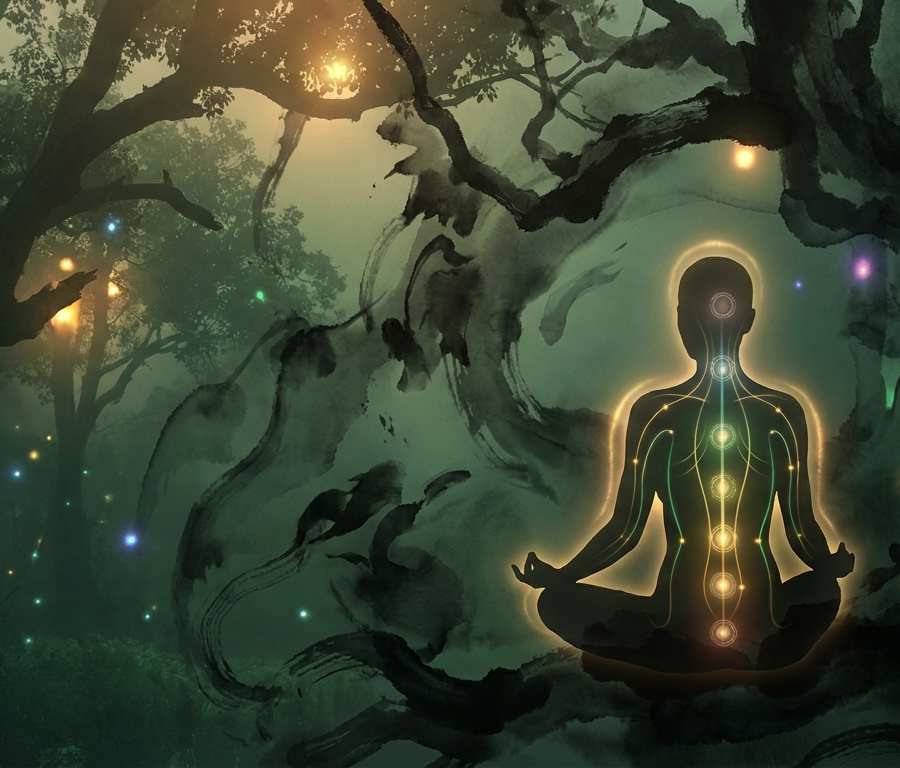
Study the course's comparison of chakra traditions and Traditional Chinese Medicine, including seven major chakras, twenty-one minor chakras, meridians and Five Element theory. Learn to distinguish source point maps and traditional interpretations from established anatomy and clinical evidence. Condition examples support critical reading of the source; practical needling requires qualified professional training.
Module 1: Module 1: Introduction to Energy Medicine
5 lessons · 25 minWhat qi and prana mean, the two systems this course compares, and how traditional ideas about symptoms and causes differ from a medical diagnosis.
- Qi, Prana, and the Meanings of Energy5 min
- Two Ancient Systems, One Goal5 min
- Symptoms, Causes, and Traditional Interpretation5 min
- The Four Bodies5 min
- What You Will Be Able to Do5 min
Module 2: Module 2: The Human Energy Field
6 lessons · 30 minThe aura, the etheric body, how energy flows, chakra states, and the autonomic nervous system connection.
- The Aura5 min
- The Etheric Body5 min
- Channel Imagery: Meridians and Nadis5 min
- Chakra States: Balanced, Congested, and Depleted5 min
- The Autonomic Nervous System and the Chakra Analogy5 min
- Endocrine Functions and Symbolic Correspondences5 min
Module 3: Module 3: The Seven Major Chakras
10 lessons · 50 minEach chakra studied in depth: location, function, organs, endocrine connections, and psychological profiles.
- Overview of the Seven Chakras5 min
- The Crown Chakra (Sahasrara)5 min
- The Brow Chakra (Ajna)5 min
- The Throat Chakra (Vishuddha)5 min
- The Heart Chakra (Anahata)5 min
- The Solar Plexus Chakra (Manipura)5 min
- The Sacral Chakra (Svadhisthana)5 min
- The Base Chakra (Muladhara)5 min
- The Coupled Chakra System5 min
- Chakra Correspondences at a Glance5 min
Module 4: Module 4: The Twenty-One Minor Chakras
6 lessons · 30 minLocations, pairings, coupling with major chakras, and how the source uses them in its pain schedules.
- What Are the Minor Chakras?5 min
- Locations and Pairings5 min
- How Minor Chakras Couple with Major Chakras5 min
- Comparing Minor-Chakra Pain Schedules5 min
- The Spleen Chakra: The Eighth Chakra?5 min
- Practical Considerations5 min
Module 5: Module 5: Introduction to TCM
5 lessons · 25 minFoundations of Traditional Chinese Medicine: Qi, Blood, Body Fluids, Yin-Yang, and the twelve organs.
- The Foundations of TCM5 min
- Qi, Blood, and Body Fluids5 min
- Yin and Yang5 min
- The Twelve Organs of TCM5 min
- How TCM Connects to the Chakra System5 min
Module 6: Module 6: Meridian System and Acupoints
5 lessons · 25 minThe twelve main meridians, eight extraordinary meridians, acupoint types, and the terms the source uses for its method.
- The Twelve Main Meridians5 min
- The Eight Extraordinary Meridians5 min
- Types of Acupoints5 min
- Reading the Chakra Acupuncture Method5 min
- Stimulation and Sedation: Source Terminology5 min
Module 7: Module 7: Five Element Theory
6 lessons · 30 minThe five elements, generating and controlling cycles, chakra connections, and how to read a Five Phase case example.
- The Five Elements5 min
- The Generating Cycle (Sheng Cycle)5 min
- The Controlling Cycle (Ko Cycle)5 min
- Five Elements and the Chakras5 min
- Interpreting a Five Phase Case Example5 min
- The Five Element Correspondences Table5 min
Module 8: Module 8: Traditional TCM Examination Methods
6 lessons · 30 minThe four traditional methods (observation, pulse reading, abdominal maps, questioning) and how TCM patterns compare with chakra interpretations.
- The Four Traditional Examination Methods5 min
- Observation5 min
- Traditional Pulse Reading: Terms and Limits5 min
- Traditional Abdominal Maps: Reading the Source5 min
- Questioning5 min
- Comparing TCM Patterns and Chakra Interpretations5 min
Module 9: Module 9: How the Source Describes Pain
5 lessons · 25 minThe source's chakra approach to pain, its regional schedule index, and how to evaluate its pain claims.
- The Chakra Approach to Pain5 min
- The Source’s Regional Schedule Index5 min
- Evaluating the Source’s Pain-Treatment Claims5 min
- Persistent Pain: Source Themes and Uncertainty5 min
- Reading Point Formulas: Limits and Missing Information5 min
Module 10: Module 10: Connecting the Systems
5 lessons · 25 minThe source's synthesis: the organ-chakra map, its major-chakra point tables and their conflicts, and reading the body through both lenses.
- The Synthesis Begins Here5 min
- The Organ-Chakra Map5 min
- Understanding the Logic5 min
- Major-Chakra Point Tables: Comparison and Conflicts5 min
- Reading the Body Through Both Lenses5 min
Module 11: Module 11: Hormone Physiology and the Source's Claims
6 lessons · 30 minBasic physiology of adrenaline, thyroid hormones, sex hormones, cortisol and cortisone, set beside the source's claims about chakra points.
- Pituitary Physiology and the Source’s Hormone Claims5 min
- Adrenaline: Physiology and Source Claims5 min
- Thyroid Hormones: T4, T3, and Source Claims5 min
- Estrogen and Progesterone: Physiology and Source Claims5 min
- Cortisol and Cortisone: Reviewing the Source Claims5 min
- Reviewing the Source’s Hormone Summary5 min
Module 12: Module 12: How the Source Describes Chronic Conditions
5 lessons · 25 minThe source's six chakra combinations, its sequence, worked examples, and principles for evaluating treatment claims.
- Reading Claims About Chronic Conditions5 min
- The Six Chakra Combinations5 min
- Reading the Combination Sequence5 min
- Worked Examples5 min
- Principles for Evaluating Treatment Claims5 min
Module 13: Module 13: How the Source Describes Named Conditions
11 lessons · 55 minHow the source groups conditions such as asthma, insomnia, back pain, arthritis, psoriasis, depression and hypertension, and how its patterns differ from a medical diagnosis.
- Comparing Traditional Patterns and Medical Diagnoses5 min
- Chronic Sore Throats and Colds5 min
- Asthma5 min
- Insomnia5 min
- Chronic Lower Back Pain5 min
- Dysmenorrhea5 min
- Rheumatoid Arthritis5 min
- Psoriasis5 min
- Depression and Anxiety5 min
- Frozen Shoulder5 min
- Hypertension5 min
Module 14: Module 14: Biomagnetics and Copper-Zinc Needles
8 lessons · 40 minThe source's alternative tools, copper and zinc needles and static magnets, its tables for them, and what the evidence says.
- Alternative Tools: Properties and Evidence5 min
- Copper and Zinc Needles5 min
- Biomagnetic Therapy5 min
- Major-Chakra Magnet Labels in the Source5 min
- Minor-Chakra Magnet Groups in the Source5 min
- The Hand-Pain Magnet Example: A Source Conflict5 min
- Combination Magnet Tables: Source Variants5 min
- Practical Reminders5 min