CFCWA Shaolin Forms: Video Library
Stream-only demonstrations of the CFCWA forms, grouped by rank, hand forms and weapons.
Martial Arts · Martial History & Supporting Studies
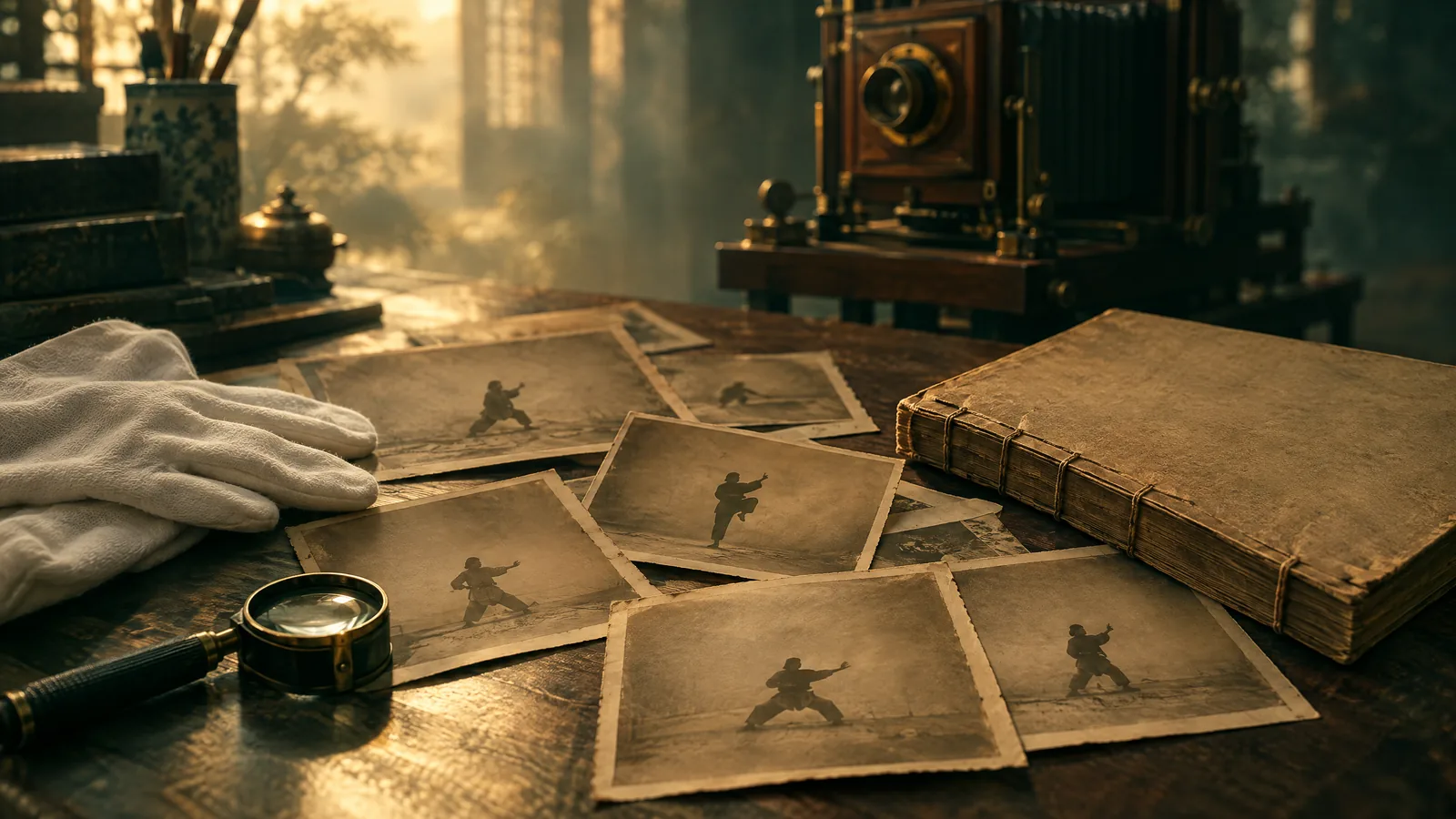
Reading the famous forms and stances from the original manuals of 1915 to 1930.
Monthly: $0 today with a card, then $34 on day 8 unless you cancel before then. After the trial, 30 days' notice applies. Active on-campus students have academy access included. Check your existing student account before buying another subscription.
For most of their history the tou lu passed body to body. A form lived only in the people who carried it, and when they died it changed or vanished. Then, between 1915 and 1930, a handful of masters stood in front of a camera and let their postures be fixed on a plate.
This course studies those photographs. We work from the original manuals (Sun Lutang's studies of xingyi, bagua and taiji, Chen Weiming's 1925 record of Yang Chengfu, and the Luohan material of the 1920s), reading each posture for what it shows about stance, structure, weight and intent. Along the way we look at what the camera preserved, what it quietly destroyed, and how to study a still image without mistaking it for the movement it came from.
All photographs used here are from works published in 1930 or earlier and are in the public domain.
What changed when the forms were photographed for the first time, and how to read a plate.
The fifty solo plates of Chen Weiming's manual, the most complete photographic record of the Yang form in its own era.
Xingyi (1915), bagua (1917) and taiji (1921): one man, three arts, photographed across six years.
Two Luohan manuals from 1924 and 1930, compared with the eighteen Luohan work taught at Cloud Forest.
Comparing stances across systems, and turning photographic study into training.
Stream-only demonstrations of the CFCWA forms, grouped by rank, hand forms and weapons.
Hand forms, animal forms, weapons, Chin Na, and partner drills on video.
The Wood Element stage of Iron Palm training on video.