Stillness Before the Lens: The Classical Tou Lu in Their First Photographs
Reading the famous forms and stances from the original manuals of 1915 to 1930.
Martial Arts · Taijiquan
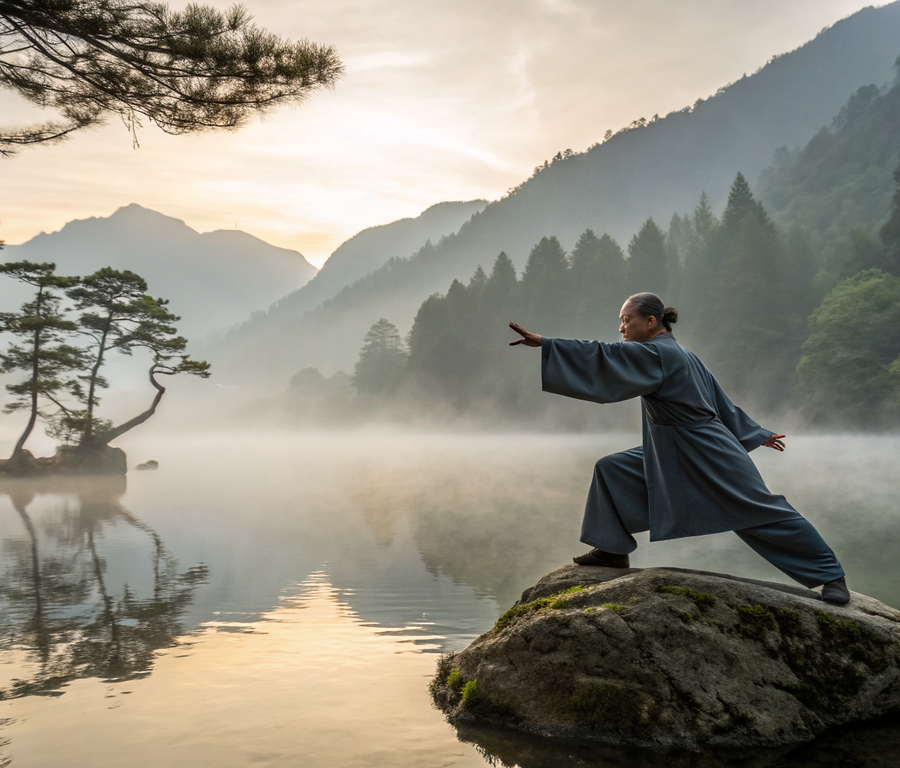
The internal principles, classical forms, and martial applications of Tai Chi Chuan.
Monthly: $0 today with a card, then $34 on day 8 unless you cancel before then. After the trial, 30 days' notice applies. Active on-campus students have academy access included. Check your existing student account before buying another subscription.
A reading course on the principles of taijiquan, the art that unites the civil and the martial, the yin and the yang. It draws on Andrew Townsend's study under Master James Huang and Grandmaster Jesse Tsao. You will learn the theoretical foundations (Taiji, Five Phases and Bagua theory), the Taoist philosophy behind the art, and a training sequence: song, preparing the body, cultivating and circulating qi, the postures, jin and pushing hands, weapons, and spiritual practice. The course has no video demonstrations, so learn the movements themselves from a teacher.
The theoretical and philosophical roots of taijiquan: Taiji, Five Phases and Bagua theory, and the Taoist worldview behind the art.
Song, the release, openness and sinking that is the first principle of taijiquan, and the fundamental principles the masters set down.
Preparing the body through stretching, loosening, silk-reeling and zhan zhuang standing, so that it can become song and root.
What the tradition means by qi, and how this course approaches cultivating and circulating it.
Learning the individual postures, their structure and transitions, and the shared principles beneath the Chen, Yang, Wu and Sun family styles.
The martial side of the art: defensive and offensive jin, the sensitivity of pushing hands, and the applications of the postures.
The classical weapons, and taijiquan as a spiritual practice that refines the Three Treasures.
Reading the famous forms and stances from the original manuals of 1915 to 1930.
Stream-only demonstrations of the CFCWA forms, grouped by rank, hand forms and weapons.
Hand forms, animal forms, weapons, Chin Na, and partner drills on video.